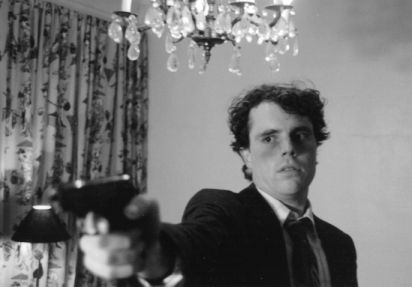
About the Production
'SOMETHING BETTER' is a 16mm independent film, shot in San Francisco and
produced under a Screen Actors Guild Experimental Film Agreement. With
cutting edge comedic style and content reminiscent of 'Leaving Las
Vegas' and 'Trainspotting', 'SOMETHING BETTER' is a hilarious dark
comedy and a touching drama with a philosophical twist. Running time is
one hour and fifty minutes.
GENESIS-
One summer day, Laurel Hunter returned from vacation to find that a
window near the fire escape of her fifth floor apartment had apparently
been forced open. Her place had been ransacked and many of her things
had been taken, including her computer and an eight-track recording
board that she and her then husband had acquired to make audio
recordings of novels. Suspicious about a burglar who would choose a
fifth floor apartment rather than one closer to the street or the roof,
she had a pretty good hunch that whoever had broken into her apartment
was someone she knew and the forced entry was staged to make it look as
though someone had entered from outside the building. Not one to be
materially inclined anyway, and because she really didn't know if the
person she suspected had taken her things or not, she let the incident
go quickly and moved on with everyday life.
Ironically, Hunter began to run into the person she suspected
everywhere: on the street, the city bus, at the grocery store. She
became intrigued with this person and found herself talking to him at
length whenever she could. She knew from talking to others that this
character was mostly unemployed and holding down menial temporary jobs
at best. As she got to know him, she was intrigued by his fantastic
ideas about who he actually was. He fancied himself a musician, with a
"big record deal in the works." His enthusiasm was profound and the
details of his fantasy life were incredible. It occurred to Hunter that
his perception of himself was completely real as far as he was
concerned. Sadly, Hunter had learned quite a bit about this person; that
he was floating from one unreliable situation to another, barely holding
on.
Much time had passed since the burglary when one day Hunter asked him
how his record was coming along. He offered an extraordinary story about
its progress and when Hunter asked him where he was recording, he told
her at his sister's house on an eight track recording board. When she
asked him if it was similar to the one she used to have he said that it
was, not realizing that he shouldn't have any prior knowledge of her
recording board, thus proving her theory about him being the thief.
Meanwhile, Hunter was engaged in further character studies at an inner
city bar. She was continually struck by the predictable manifestation of
alcoholic highs and lows. It seemed that every person she talked to had
begun an enthusiastic journey upward, only to fall shamelessly to the
throws of anger, resentment and negativity. She was struck by personal
reality, which could seemingly change within seconds. What was true in
one moment was no longer true in the next, all because of a negative
shift in perspective.
These experiences and character studies, as well as many, many others,
were the genesis of SOMETHING BETTER. Hunter has always been fascinated
with human belief systems, including psychology, philosophy, religion
and science. SOMETHING BETTER springs from a fascination with human
perspective; the way that people live in their minds; how convinced they
can become of the realities they have created; how changeable reality is
in the human mind. This is a favorite subject in Hunter's writing and
she returns to it again and again.
ABOUT THE PRODUCTION
This production has found its way through incredible highs and lows.
After shooting commenced, trouble arrived for Hunter and her then
partner Allen, with whom she was collaborating on the film. After
working together for eleven years, Hunter and Allen made the decision to
terminate their long-standing partnership and questions arose as to who
would finish the film. This caused the project to be put temporarily "on
the shelf" while the two sorted out the details. During this time,
another tragedy occurred. Hunter and Allen received news that Director
of Photography, Steve Kang, had been killed in a car accident not long
after completing shooting. Hunter and Allen were devastated by the news,
and at that point the two made the decision to put the project on hold
until emotional wounds could begin to heal and a decision could be made
as to who would finish the film.
Ultimately, Hunter, who had written the script and then co-produced it
to that point with Allen, was unwilling to let the film go. Allen went
on to produce his own script, COFFEE AND LANGUAGE, and Hunter began
making arrangements and finding funding to finish SOMETHING BETTER on
her own. Things began looking up when she met film editor, Rick Niemetz.
Hunter and Niemetz spent the next year editing the film and forming
Hunter's new production company, Lucky Dog Films and Theatre
Productions. Yet by the end of the editing process, which involved
editing out set conversations with Kang, Hunter was emotionally
exhausted. With money running short once again, she decided to shelf the
project for another short period and focus on fundraising for the
soundtrack.
Once funds were in place, things began looking up again. Hunter met
filmmaker Mary-Lyn Chambers who hooked her up with New York born scoring
artist Lance Bendiksen. Bendiksen rounded up a number of talented
musicians, including John Magnie of the SUBDUDES. The sound track was a
delicate matter as Hunter had committed to a minimal filming style. Once
a balance was achieved between filmmaker and scoring artist, the project
was finally completed on June 15, 2002.
CASTING-
Casting for the film proved to be a difficult task, mainly because of
the nature of the script, which was originally written for the stage.
While the directors openly challenged the broadly accepted notion that
theatre and film are incompatible animals, they also had to acknowledge
the differences between film and stage acting talent and techniques. Due
to the budget of the film and because of the long scenes, experienced
stage actors were essential. The budget did not allow for multiple takes
of scenes that frequently ranged from fifteen to thirty minutes and
sometimes ran out entire rolls of film on a single take.
The casting process began with auditions. Open casting calls were set up
in San Francisco where in a period of two days directors J.P. Allen and
Laurel Hunter saw dozens of Bay Area actors. Ironically, the audition
brought only two actors, Drew Anderson (the Vietnam Vet) and Mark
Phillips (Sam). Phillips was initially dismissed as a possibility only
because he seemed too young and clean-cut for the part of Sam, who
Hunter saw as much older and hardened. Yet Phillips strong audition had
placed him firmly in the directors' minds, and they hesitantly gave him
a call back. The clean cut Phillips had taken a script home with him,
and showed up at the call back completely transformed into a character
that Charles Bukowski would have been proud of. He delivered his
interpretation of the role impeccably and the thrilled directors agreed
upon him immediately, a decision that proved to be one of the most
important and influential decisions in the destiny of the project. Drew
Anderson was cast for the part of the Vietnam Vet because of his
intensity as an actor and his extraordinary acting ability. Both
directors were familiar with his performance in a Bay Area production of
Arthur Miller's 'The Crucible' and were immediately impressed with his
talents.
All other roles remained unfilled except for Patrick, which was
specifically written for Pat Everett. The directors met him on a
production of one of Hunter's plays when it was first produced in San
Francisco. He gave an outstanding performance and became fast friends
with both the directors and would go on to work with either of them on a
number of projects.
Discouraged by the audition process, the directors, who couldn't afford
mistakes in casting, decided upon known elements. Both actors and
playwrights, they began to contact from a talent pool they knew who had
exceptional experience and training. They convinced Allen's friend,
Matthew Davis, who had recently left behind a four-year stint at the
Oregon Shakespeare Festival to play Skip, and Chicago based actor Kim
Ataide, a working theatre actor and former Cal Arts Acting Program
graduate, to play Sally.
Brenda Hayes, also a Cal Arts graduate working in Los Angeles, agreed to
play Justine. Being actors themselves, Allen and Hunter assumed the
remaining roles of Mary and Eddy.
LOCATION-
The film was shot mainly in San Francisco even though you will not find
the cities epic views and historic landmarks in the film. Hunter and
Allen were out to create a claustrophobic atmosphere, thus forcing the
cast and crew to spend multiple hours each day in cramped, smoke-filled
spaces. Ninety-nine percent of the shots were interior to capture the
small world of the main characters. Much of the filming was done in an
apartment that Hunter and Allen shared at the time; the rest was filmed
at Catz Bar and Grill, south of Market Street in San Francisco. Pick up
shots were filmed at Niemetz's house in Denver.